Key Takeaways
- A French drain is a subsurface drainage system that redirects water away from problem areas before it can damage your lawn, landscape, or foundation.
- Poor drainage left untreated causes plant loss, foundation stress, and standing water.
- Proper installation depends on slope, soil type, pipe material, and discharge point. All of which require professional assessment.
- French drains can be designed to integrate seamlessly with high-end landscape design, becoming invisible features within a beautiful outdoor environment.
- Professional landscape planning ensures drainage is addressed before hardscaping, planting, and outdoor living zones are built.
Water is one of the most damaging forces a backyard can face. It moves quietly, accumulates in places you cannot always see, and slowly compromises everything you have invested in your outdoor space. For homeowners dealing with soggy lawns, pooling water near the house, or patches of dead grass that never seem to recover, the problem is almost always drainage.
A French drain is one of the most effective solutions available. It works underground, removes water passively, and when planned well, fits invisibly into a beautifully designed landscape. But understanding how it works, when it is needed, and what makes an installation succeed or fail is important before committing to any drainage project.
This guide covers everything you need to know about French drain backyard drainage, from the basics of how the system works to how it integrates with luxury landscape design for results that are both functional and beautiful.
How Does a French Drain Work
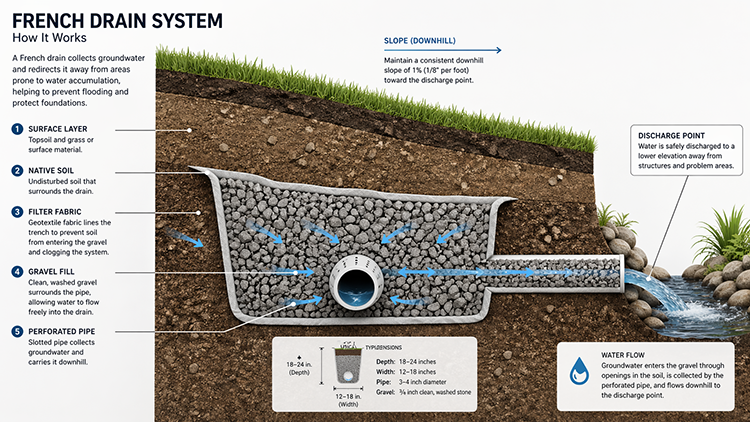
A French drain works entirely on gravity. The perforated pipe is installed at a consistent downward slope. Generally, a minimum fall of one inch for every ten feet of pipe run. This slope is critical. Without it, water collects inside the pipe rather than moving through it, and the system fails to function.
When rain falls or groundwater rises, water follows the path of least resistance. The gravel-filled trench acts as an artificial low point, drawing water down and into the perforated pipe. The pipe carries that water downhill to the discharge point, where it exits through a pop-up emitter, open pipe end, or into a dry well, depending on site conditions.
The filter fabric wrapped around the gravel plays a quiet but important role. It prevents fine soil particles from migrating into the gravel bed and eventually clogging the pipe. Without it, even a well-installed French drain can fail within a few years as silt accumulates and blocks water flow.
Proper slope, the right pipe material, and quality filter fabric are not optional details. They are the difference between a system that works for decades and one that needs to be dug up and replaced within a few years.
Where Should a French Drain Be Placed
Placement depends entirely on where water originates, where it is collecting, and where it can safely discharge. There is no single correct placement for all yards. Every property has its own topography, soil conditions, and drainage challenges.
Common placement scenarios include:
- Along the perimeter of the home to intercept water migrating toward the foundation
- Across the low point of the yard to capture pooling water before it saturates the soil
- At the base of a slope where runoff accelerates and concentrates
- Along property lines where water enters from adjacent land
- Behind retaining walls to relieve hydrostatic pressure from trapped groundwater
We often find that homeowners assume drainage is a single-point problem. In reality, water moves across an entire property, and the best French drain placement addresses the full flow path. This is why a proper site assessment before any installation is essential.
What Are the Most Common French Drain Mistakes

Poor drainage work is surprisingly common. The mistakes tend to fall into predictable patterns, and understanding them helps homeowners recognize quality planning versus shortcuts.
An incorrect slope is the most frequent problem. A French drain that runs flat or drops inconsistently creates standing water inside the pipe. The system looks installed but does not function. Correcting this requires digging up and relaying the entire run.
Wrong pipe material is a close second. Flexible corrugated plastic pipe is the cheapest and most commonly used material. It is easy to work with and cuts installation time. It is also prone to silt accumulation in its ridges and compression failure in heavy or shifting soils. In clay-heavy regions especially, corrugated pipe often needs replacement within ten years. Rigid smooth-walled pipe is more durable and far more likely to perform over the long term. Smooth-walled PVC has a Manning’s n-value of 0.009, allowing water to flow more efficiently compared to the traditional design value of 0.013 used for many sewer systems.
No filter fabric or inadequate fabric allows fine soil particles to migrate into the gravel bed. Over several years, this silts up the system and blocks water movement.
Discharge point problems are also common. A French drain is only effective if it can actually discharge water somewhere. Installing a drain without confirming a viable, compliant discharge point results in a system that redirects water temporarily and then backs up under the yard.
Installing drainage after hardscaping is a costly sequence error. Retrofitting drainage around existing hardscape is far more expensive and often requires compromising other features. Drainage planning should always happen first.
Why Does Professional Planning Make a Difference
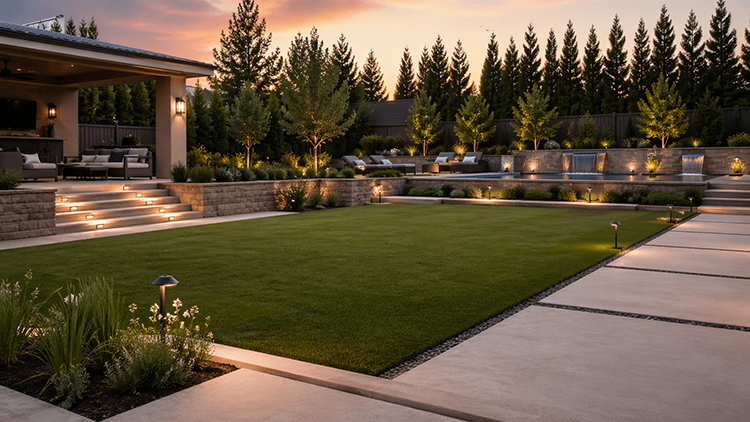
French drains are conceptually simple. That simplicity can make them appear easy to install correctly. In practice, the details that determine whether a system works for five years or thirty are highly technical.
Proper grade, correct pipe specification, appropriate gravel and fabric selection, viable discharge point confirmation, soil assessment, storm volume calculation; these are not tasks that benefit from guesswork. An improperly installed French drain does not just fail to solve the problem. It often makes it harder to solve later, because the failed system now occupies the space where the correct system needs to go.
At Sol & Arbor, drainage planning is built into our luxury backyard design process. We do not treat it as an add-on or a contractor’s concern. Water management decisions shape grading, planting zones, hardscape placement, and outdoor living layouts. When drainage is integrated from the start of a design, the entire backyard performs better and the investment in every other element is protected.
Our remote design process gives homeowners across the country access to expert-level landscape planning that addresses drainage as part of a complete outdoor vision, not as an afterthought.
Final Takeaway
Drainage is not a problem to solve after your backyard is designed; it is a design problem in its own right. A French drain system that is properly planned, correctly installed, and thoughtfully integrated into your landscape can function invisibly for decades, protecting your foundation, your planting investment, and the full usability of your outdoor space.
The homeowners who get the best results treat drainage as a first step in landscape design rather than a last resort when problems become unavoidable. That sequence matters. It protects the investment in everything that follows the hardscape, the plantings, the outdoor living zones, and the experience of the space itself.
At Sol & Arbor, we design luxury backyards where function and beauty are never in conflict. Our remote landscape design process integrates drainage planning, grading considerations, and water management into every custom plan so your backyard looks exceptional and performs reliably, season after season.
If you are ready to design an outdoor space that works as well as it looks, explore our backyard landscape design packages and connect with our team.