Key Takeaways
- Stepping stone pathway design in a side yard goes far beyond material selection. Spacing, layout pattern, and stone size all determine how safe, usable, and visually cohesive the path feels.
- Material choice matters more in side yards than anywhere else on your property. Drainage, shade exposure, and traffic frequency should guide every decision.
- Lighting transforms a side yard pathway from a purely functional corridor into a polished design feature that enhances both safety and curb appeal after dark.
- Ground cover between stones is one of the most overlooked design decisions. The wrong filler creates constant maintenance. The right one practically takes care of itself.
The side yard is one of the most underused spaces on a residential property. Most homeowners treat it as a pass-through, a place for utility equipment, or just a strip of struggling grass that never quite looks right. What it should be is a well-designed corridor that connects the front and back of your property with intention, safety, and visual appeal.
A stepping stone pathway is one of the most effective ways to transform a side yard. Done well, it solves the drainage problems that plague narrow spaces, eliminates the need for grass that barely survives in low-light corridors, and creates a clean, purposeful line through the space. Done poorly, it becomes a tripping hazard, a maintenance problem, or a visual afterthought that clashes with the rest of your landscape.
This guide goes deep into every dimension of stepping stone pathway design for side yards. We cover materials, spacing principles, lighting integration, ground cover options, and the layout decisions that separate a professional result from a DIY attempt that never quite works. Whether you are starting from scratch or rethinking an existing path, what follows will give you a clear picture of how to approach this thoughtfully.
How Do You Choose the Right Stone Material for a Side Yard Path
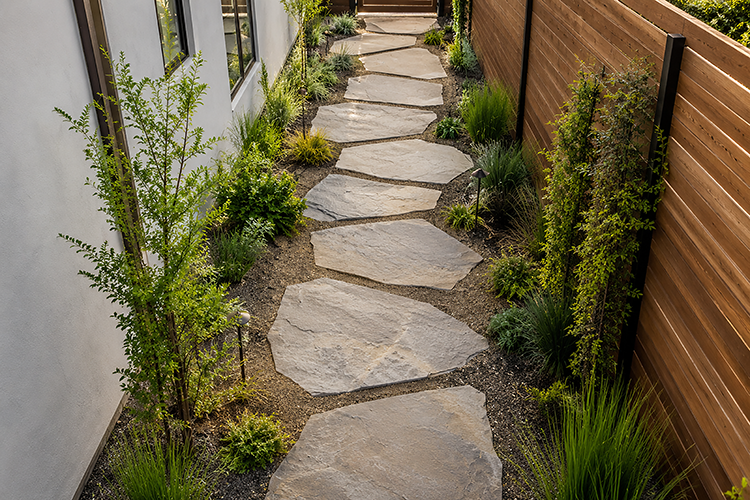
Material selection is the decision that will most directly affect the long-term performance of your path. Each material has specific strengths and limitations, and those need to be weighed against the actual conditions of your side yard.
Natural Flagstone
Flagstone is one of the most popular choices for residential stepping stone paths, and for good reason. It is a flat, natural stone that comes in a wide variety of colors and shapes, most commonly in irregular forms that give a path an organic, casual character. Common varieties include bluestone, Tennessee crab orchard, limestone, and sandstone.
In a side yard, flagstone works well when the path does not carry heavy load traffic. It provides excellent visual texture and ages gracefully, developing a natural patina over time. The primary consideration is thickness. For a stepping stone application, you need flagstone that is at least 1.5 inches thick, and ideally closer to 2 inches, to resist cracking under foot traffic. Thinner pieces are more prone to breaking, particularly if the base beneath them is uneven or soft.
One limitation worth noting: flagstone can become slippery when wet, particularly varieties with a smoother finish. In a side yard that stays shaded and damp, this is a real safety concern. Selecting rougher-textured flagstone or adding a non-slip treatment addresses this.
Concrete Pavers
Manufactured concrete pavers offer a level of consistency that natural stone cannot match. They come in standardized sizes, which makes layout planning straightforward, and they are engineered to provide a stable, non-slip surface. For side yards with heavy foot traffic, frequent use by children, or areas adjacent to utility access points where people are carrying bins or equipment, concrete pavers are often the smarter choice over natural stone.
Large-format architectural slabs, typically 18×18 inches or 24×24 inches, are a particularly strong option for side yards. They cover more ground with fewer stones, which reduces grout lines and simplifies maintenance. Their clean, geometric appearance works well with contemporary home styles. Textured or brushed finishes provide grip in wet conditions.
The cost of concrete pavers generally comes in lower than that of premium natural stone, and they resist cracking better over time. The trade-off is that they lack the visual character and uniqueness of natural materials. On a luxury property, pavers are often used as a complement to natural stone rather than a replacement.
Irregular Fieldstone and Boulders
For properties with a more naturalistic aesthetic, irregular fieldstone creates a path that feels like it grew organically out of the landscape. Large, flat-topped stones of varying sizes are arranged in a loose, stepping sequence through the corridor. This style works especially well when the side yard is planted with lush, informal groundcovers that spill between and around the stones.
The key challenge with fieldstone is sourcing pieces that are both flat enough to walk on safely and heavy enough to stay in place. Stones that rock or shift underfoot are a safety problem. Proper base preparation and careful selection of individual pieces are essential.
Decomposed Granite and Gravel Fill Paths
A stepping stone path does not have to be made of stone alone. Some of the most effective side yard designs use larger stepping stones set within a bed of decomposed granite or pea gravel. The stones provide a firm footing on the walking line, while the loose-fill material covers the surrounding ground, suppresses weeds, and manages drainage effectively.
This combination is particularly well-suited to side yards with drainage challenges. Loose-fill materials allow water to percolate through rather than pooling on the surface. A properly installed decomposed granite base (at least two inches, compacted in layers) provides a stable, non-muddy surface between the stones.
The visual contrast between the stepping stones and the gravel fill can be quite striking. Dark, smooth stones against light-colored gravel create a clean, graphic quality. Warmer stone tones against natural-colored decomposed granite produce a more relaxed, organic effect.
What Are the Most Important Spacing Principles for Stepping Stones

Stone spacing is where most homeowners make the first significant design mistake. Spacing is not arbitrary. It is determined by human stride length, safety requirements, the visual rhythm you want to create, and the width of your side yard corridor.
The standard guidance for stepping stone spacing is based on average adult stride. Stones set 18 to 24 inches apart, measured from center to center, accommodate comfortable walking without requiring awkward short steps or long stretches. Spacing tighter than 18 inches feels crowded and choppy. Spacing wider than 24 inches forces most adults into an unnatural gait and increases the risk of stepping off the stone.
For children or elderly users, tighter spacing in the 16 to 18 inch range improves accessibility and safety. For purely aesthetic paths where movement is meant to be slow and deliberate, such as through a garden, wider spacing of 24 to 30 inches creates a more contemplative pace.
In a side yard, the width of the corridor often affects the number of stones across the path. A narrow side yard of four feet or less is typically served by a single-file path. Wider side yards of six feet or more can accommodate two stones side by side, creating a path wide enough for two people to pass or for carrying wider loads. Two stones across also allows the path to feel more like a proper walkway rather than a purely functional stepping sequence.
Stone size relative to spacing matters as well. A common principle is that the stone itself should be at least as wide as the gap between stones. When gaps are larger than the stones, the path begins to feel scattered and disconnected. When stones are large and gaps are narrow, the path reads as a continuous surface with accent gaps rather than isolated stepping points.
Which Layout Patterns Work Best in Narrow Side Yards
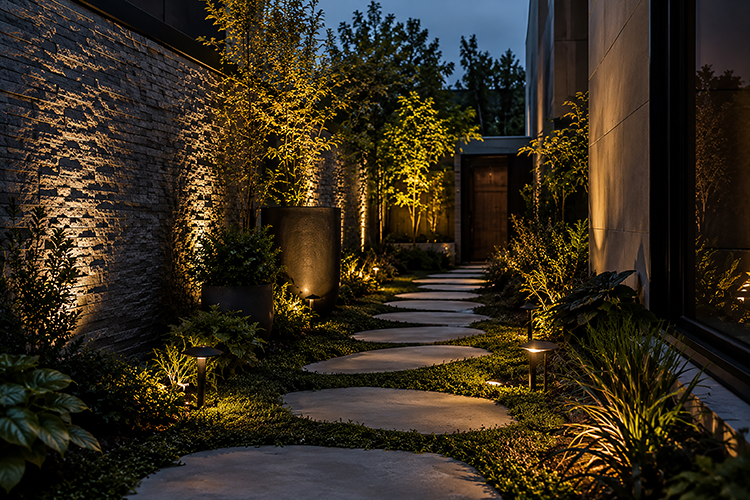
Layout pattern, meaning the visual arrangement of stones along the path, affects how the space feels and how well it performs. Several distinct approaches suit the side yard context. According to NAR, 92% of realtors recommend improving curb appeal before listing, with defined pathways consistently identified as a high-impact first-impression feature
The Linear Sequence
The most straightforward layout places stones in a single straight line from one end of the side yard to the other. This works well in very narrow corridors where there is no room for variation and where the primary function is efficient passage. The linear approach emphasizes the directional quality of the space, which can feel clean and purposeful or institutional and dull depending on execution.
To add interest to a linear layout without widening the footprint, vary the stone size slightly. Alternating between a larger primary stone and a slightly smaller secondary stone creates a subtle rhythm that breaks the monotony without requiring additional width.
The Offset or Staggered Sequence
Placing stones in a slightly staggered offset, where alternating stones shift a few inches to one side or the other, creates a subtle sense of movement and liveliness. It does not require significantly more width than a straight single-file path, but it reads as more deliberately designed. The eye follows the gentle zigzag pattern, which makes the path feel dynamic rather than static.
This layout also has a practical benefit. The slight variation in position means footfall is distributed across a slightly wider strip of the path base, which reduces wear and compaction in a single central line.
The Wide Two-Column Layout
In side yards wide enough to accommodate it, placing two stones side by side creates a path that feels generous and considered. The two-column format is particularly effective when the stones are large-format pavers or cut bluestone, where the regularity of the grid creates an almost architectural quality.
This layout works best when the side yard has been designed as a destination or functional space in its own right, not purely as a transit corridor. A wide stepping stone path flanked by low plantings and lit at night can function as an outdoor room in a compact but beautifully resolved side yard.
The Naturalistic Curved Path
A gently curving path that weaves slightly through the side yard introduces an organic quality that contrasts pleasingly with the linear architecture of house walls and fences. The curve does not need to be dramatic. Even a shallow S-curve over the length of a typical side yard creates a sense of discovery and slows the pace of movement in a way that straight paths never do.
Curved paths require slightly more planning to execute well. Each stone in the curve must be positioned so the walking line remains comfortable. Tight curves with large stones can force awkward foot placements. Curving paths also tend to work better with irregular, organic materials like flagstone or fieldstone than with geometric cut stone or square pavers.
What Ground Cover Options Work Best Between Stepping Stones
The material between your stepping stones is not a secondary decision. It directly affects how much maintenance the path requires, how the path performs in wet conditions, and how the overall design reads visually.
Creeping Thyme
Creeping thyme is one of the most widely recommended ground covers for stepping stone paths, and it earns that reputation. It tolerates moderate foot traffic, stays low (typically under two inches in height), spreads gradually to fill gaps, and releases a pleasant herbal scent when brushed. It flowers in small pink or purple blooms in summer, which adds seasonal color without requiring any effort.
In shaded side yards, creeping thyme performs less reliably. It prefers at least partial sun. In heavily shaded corridors, consider shade-tolerant alternatives.
Irish or Scotch Moss
For side yards that receive little direct sun, Irish moss (Sagina subulata) and Scotch moss (Arenaria verna) are compact, dense ground covers that maintain a lush, almost velvety appearance in moist, shaded conditions. They form a low, cushioned surface between stones that feels almost manicured without requiring constant attention.
Both varieties prefer consistent moisture, which makes them a natural fit for the drainage-heavy conditions common in side yards. They do not tolerate drought well, so in climates with dry summers, irrigation or rainfall supplementation is necessary.
Dwarf Mondo Grass
Dwarf mondo grass (Ophiopogon japonicus ‘Nanus’) is a compact, very low-growing grass-like plant that handles shade, moderate traffic, and varying moisture conditions with remarkable resilience. It stays dark green year-round in mild climates, which makes it a strong choice for side yards that are visible from the street or from primary outdoor living areas.
It grows slowly, which means it takes time to fill gaps, but once established it requires minimal intervention. It does not need mowing, tolerates periodic dryness once established, and spreads steadily to fill in over two to three seasons.
Pea Gravel and Decomposed Granite
For side yards where organic ground cover is impractical due to extreme shade, very heavy foot traffic, or low-maintenance priorities, inorganic fill materials are a reliable and often visually strong option. Pea gravel (rounded, smooth aggregate in the three-eighths to half-inch range) and decomposed granite both drain well, suppress weeds when installed over landscape fabric, and provide a consistent neutral backdrop that allows the stepping stones themselves to be the design focus.
Decomposed granite compacts over time, which can actually be desirable in high-traffic side yards because it becomes firmer underfoot. Pea gravel remains loose, which means it can migrate onto the stone surfaces and requires occasional raking to keep the path looking tidy.
How Does Lighting Transform a Stepping Stone Pathway
Lighting is the element that most dramatically changes the after-dark experience of a side yard pathway. A well-lit path is a safety feature. It is also a design feature, one that makes the exterior of a home look considered and refined in the evening hours when many luxury properties are at their most visually striking.
Several lighting approaches work well with stepping stone paths in side yards.
Path Lights
Low-profile path lights placed at regular intervals along the edges of the stepping stone path are the most direct solution. They cast light onto the stone surfaces at an angle that emphasizes texture and makes each stepping stone clearly visible. Spacing of eight to ten feet between path lights typically provides adequate illumination without creating an overly busy visual effect.
In narrow side yards, bollard-style path lights can crowd the corridor. Low, ground-hugging path light fixtures work better, staying close to the ground plane and keeping the center of the corridor clear.
In-Ground or Recessed Lighting
For a cleaner, more architectural look, recessed in-ground lights set into the path itself, or positioned at the base of a fence or wall, provide illumination without visible fixtures cluttering the space. This approach is more installation-intensive and typically requires hardwired fixtures rather than solar options, but the visual result is more polished and better suited to luxury residential properties.
Uplighting Adjacent Plantings
Placing small uplights in the planting beds alongside a stepping stone path, directed upward into low shrubs, ornamental grasses, or architectural plants, creates an indirect wash of light that illuminates the path without requiring lights directly on the path itself. This technique has a lush, layered quality that is difficult to achieve with standard path lights alone.
Solar vs Hardwired
Solar path lights have improved significantly in recent years and can be an effective and cost-efficient option for side yards with adequate sun exposure. The practical limitation is that side yards, being inherently shaded, may not provide enough direct sun to charge solar fixtures reliably. Hardwired low-voltage LED lighting systems are more reliable in shaded corridors and offer better long-term performance and more consistent output.
What Are the Most Common Stepping Stone Pathway Mistakes to Avoid
We see the same problems appear again and again in side yard pathway designs, both in properties we are asked to redesign and in projects where homeowners have attempted a DIY installation. Being aware of these issues upfront saves significant time, money, and frustration.
Stones That Are Too Small for the Space
Small stepping stones (under 12 inches in any dimension) look out of scale in most side yard applications. They require more stones to cover the same distance, which increases installation complexity and creates more joints for weeds to establish. More importantly, they tend to look scattered and insubstantial rather than purposeful and designed. In the side yard context, where you want the path to read clearly from a distance, larger stones (18 inches and above) almost always produce a better visual result.
No Consideration for Base Preparation
Laying stones directly on native soil is one of the most common installation mistakes. Without a prepared gravel base, stones will shift, sink, and become uneven over time, particularly in clay-heavy soils or areas with freeze-thaw cycles. Uneven stones are a safety hazard. They also make the path look neglected and poorly maintained, which works against the design investment you have made.
Ignoring the Transition at Path Ends
Many DIY side yard paths simply stop at the boundary of the side yard without any considered transition to the front or back yard. The result is a path that arrives nowhere in particular. Taking the time to design the endpoint, even if it is just a slight widening or a change in surface material, makes the path feel like a complete design gesture rather than an incomplete project.
Uniform Stone Size Throughout
Using stones of the same size in a uniform grid can make even well-executed paths feel mechanical. A small amount of variation in stone size, whether in shape (for organic materials) or placement (for cut stone), introduces the visual richness that distinguishes a professionally designed path from a standard installation.
Neglecting Weed Control
Without landscape fabric beneath the base gravel and a well-chosen ground cover between stones, weed establishment in stepping stone paths is essentially guaranteed. The joints between stones are exactly the environment that weeds prefer: loose soil, low competition, and some moisture. A quality landscape fabric layer beneath the gravel base, combined with a dense, low-maintenance ground cover, eliminates most of the ongoing weed maintenance that homeowners find frustrating.
How Do Professional Landscape Designers Approach Stepping Stone Path Planning
The difference between a professionally planned stepping stone path and a well-intentioned DIY project is usually not visible in the individual components. It is visible in the totality of decisions and how they relate to each other.
A professional designer begins with the circulation analysis, meaning they trace every route that people actually take through the property and identify where the natural desire lines are. The path is then positioned to follow those lines, which means people will actually use it rather than cutting across adjacent planted areas.
From there, material selection is driven by the specific conditions of the space, the drainage characteristics, the shade exposure, the adjacent hardscape materials already present, and the design vocabulary of the home’s exterior. This is not a generic recommendation. It is a site-specific decision informed by a complete understanding of the property.
Spacing and layout are resolved at the planning stage, often with a physical mock-up or a scale drawing, so that the rhythm of the path can be evaluated before any materials are purchased or installed. Lighting and ground cover are integrated into the plan from the beginning, not added as afterthoughts once the stones are set.
At Sol & Arbor, this whole-property perspective is what separates our remote design process from piecemeal planning. When we design a side yard stepping stone path, we are working within a complete understanding of the property, its existing hardscape, its planting design, its drainage characteristics, and the lifestyle of the homeowner. The result is a path that fits, functions, and looks like it was always meant to be there.
Final Takeaway
A stepping stone pathway in the side yard is one of the highest-impact, most practical improvements you can make to a residential property. It solves the chronic problems that afflict side yards, drainage, bare soil, poor grass performance, and unsafe footing, while simultaneously creating a design feature that adds coherence, safety, and visual refinement to the whole property.
The decisions that determine success are not complicated, but they need to be made deliberately: base preparation, material selection suited to actual site conditions, correct spacing for the intended user, appropriate ground cover, integrated lighting, and considered transitions at both ends of the path. Each element supports the others, and when they are resolved together as a unified plan, the result looks and feels effortless.
That effortlessness is the signature of professional design. What appears simple has been carefully thought through. What looks like it just belongs has been positioned, scaled, and detailed with precision.
If you want a stepping stone pathway in your side yard that achieves that quality, Sol & Arbor offers fully remote landscape design services for residential properties throughout North America. We bring the same depth of planning to side yard pathways as to full-property master plans, and we deliver detailed, buildable design documents that give your contractor exactly what they need to execute the work correctly. Your side yard has more potential than it is currently showing. We can help you realize it.
Frequently Asked Questions
What size stepping stones work best in a narrow side yard?
For side yards under five feet wide, stepping stones in the 18×18 inch range offer the best balance between visual presence and path width. In wider corridors of six feet or more, 24×24-inch stones or large, irregular flagstone pieces create a more generous, purposeful path. Stones smaller than 12 inches in either dimension tend to look scattered and out of scale in most side yard applications.
How do I stop weeds from growing between my stepping stones?
The most effective approach combines three layers of protection: a quality non-woven landscape fabric beneath the base gravel, a compacted gravel base that limits soil migration, and a dense, low-maintenance ground cover between the stones. Ground covers like creeping thyme, dwarf mondo grass, or Irish moss out-compete most weeds once established. Inorganic fill options like decomposed granite or pea gravel installed over fabric also significantly reduce weed pressure.
Can a stepping stone pathway handle heavy foot traffic and utility use?
Yes, but material and installation choices matter. Concrete pavers and thick-cut natural stone (at least 1.5 to 2 inches) on a properly compacted gravel base handle heavy residential foot traffic and occasional equipment movement without issue. For side yards where bins, carts, or other wheeled items are regularly moved, a solid paver path or larger-format stepping stones set close together (under 18 inches of open fill between stones) perform better than widely spaced individual stones in loose gravel.
Do I need a professional designer for a stepping stone pathway in my side yard?
For a simple, short path in a straightforward side yard, a well-informed homeowner with time and patience can achieve a functional result. For properties where drainage is a concern, where the side yard is part of a larger landscape design, or where material consistency with existing hardscape is important, professional design input prevents costly mistakes and produces a result that genuinely enhances the property’s value and appearance. At Sol & Arbor, we work remotely with homeowners to produce complete side yard design plans that address all of these considerations, regardless of location.